
I am a classically trained pianist who performs in any number of contexts, both popular and classical. My musical background very much informs my music reviews, as well as other art subjects I’ve covered: theater, exhibitions, music performances (classical and popular), and dance.
These pieces were published in The Martha’s Vineyard Times, a weekly newspaper published in Vineyard Haven, MA. I wrote a wide range of features for the paper from 1997-2002.
Ned Rorem
In the summer of 2000, the Martha’s Vineyard Chamber Music Society debuted “An Oboe Book” by the Pulitzer Prize winning composer, Ned Rorem. I had the honor both of interviewing Mr. Rorem before the performance, and reviewing the performance afterward. The two pieces appeared in the Martha’s Vineyard Times.
“Gift to the Island from a Musical Giant,” by Dawn Aberg (Martha’s Vineyard Times, July 6, 2000)
On Monday evening, July 10, Martha’s Vineyard audiences will have the exceptional opportunity, the pleasure, and indeed the honor, to witness the world premiere of a musical work by one of this country’s foremost composers of serious music: Ned Rorem.
At 8 pm at the Old Whaling Church in Edgartown, the Martha’s Vineyard Chamber Music Society will present Mr. Rorem’s “An Oboe Book” in the first program of its 2000 season. In a further amazing gift to our Island, a venue known more this time of year for barbecues, fishing, and celebrity watching than high culture, the composer himself will be present to deliver pre-performance remarks at the Monday evening concert.
That Ned Rorem’s name is not common currency in the provinces (where we live) is a comment on the sad state of contemporary American artistic awareness, not on Mr. Rorem’s genius. He stands as the pre-eminent composer, certainly in this country and perhaps in the world, of contemporary art song. The richness, emotional range, and precision of his work in this genre highlight his special insight into that rare space in which the worlds of words and music overlap, or sometimes collide.
His three-part song cycle for four singers and piano, “Evidence of Things Not Seen” is, according to New York Magazine’s reviewer, “one of the musically richest, most exquisitely fashioned, most voice friendly collections of songs I have ever heard by any American composer.” In an article in “Music America,” which recognized Mr. Rorem as its Composer of the Year in 1998, Allen Hughes wrote that the composer “has, for more than 40 years, steered a steady tonal and lyrical course past competing isms and fads — serialism and minimalism among them — and ended up a winner.”
Words and music: these two very different sorts of articulation reveal different aspects of voice in its more abstracted sense, and combine in Mr. Rorem’s work with an elegance of expression and thought that must be heard to be understood.
As introduction to Mr. Rorem’s work, listeners should consider the recently released “Songs of Ned Rorem” performed by mezzo-soprano Susan Graham and pianist Martin Martineau. The album has Mr. Rorem’s full endorsement. The composer considers Ms. Graham to be America’s best mezzo. “She interests me, as she has good diction,” he told The Times from his home on Nantucket, “as well as a beautiful voice.” When assessing a singer’s performance of song, Mr. Rorem stated that he looks for diction above all else, not “interpretation.” The singer should take it for granted that he or she has a beautiful voice, the composer insists, and pay attention to the words.
Although Mr. Rorem may be best known for his vocal music, his musical work extends far beyond this specialized field. He was awarded the Pulitzer Prize in 1976 for his orchestral suite “Air Music.” The Atlanta Symphony’s recording of his “String Symphony, Sunday Morning” and “Eagles” received a Grammy award in 1989. His chamber works have been toured or recorded by the Guarneri String Quartet, the Emerson String Quartet, adn the Beaux Arts Trio. Nevertheless, Mr. Rorem’s basic, and gifted, insights into voice as the heart of a lyric line extend to all his musical work. “I conceive music vocally,” he insists. “Whatever my music is written for — tuba, tambourine, tubular bells — it is always the singer within me crying to get out.”
Do not be misled into thinking that Mr. Rorem is a sentimentalist. He does not talk about inspiration when he discusses the creation of his work. In fact, attempts to draw him out regarding the creative process meet with the composer’s trademark curmudgeonly resistance (something I confess that a diehard fan finds endearing).
Instead, Mr. Rorem talks of composition in straightforward, common sensical ways. “The professional artist takes self-expression and puts it in a communicable state,” he states in a matter of fact fashion. A composer does, he admits, obey “certain rules of prosody, of innate comprehension and elegance, in how to set a phrase to music,” in taking the words and putting them in a different medium. But, when the finished work emerges, Rorem pulls no punches. “It is either good or it ain’t.”
Rorem describes his choice of texts for his vocal work as words that “speak to my condition, as we Quakers say.” Since the passing early last year of the accomplished New York organist James Holmes, Mr. Rorem’s devoted companion of over 30 years, that condition has been one of melancholy. It might seem odd to hear the creator of such exquisitely ordered gems as the 27-second “I am Rose” say it. But in Mr. Rorem’s opinion, “the whole universe is sort of random.” He is philosophical about the role of human beings on the planet. “The difference between us and other animals,” he told The Times, “is that we try to give life meaning when there is none. Art was invented to pass the time until we die.” In the face of the random nature of experience, he would “rather pass the time making art” than most other things.
In a different sort of engagement with words, Mr. Rorem is a prolific diarist and writer of essays. He qualifies these literary efforts. “I am a musician who happens to write,” he says. “Writing is the sideline.” Diaries are a unique artistic genre, “on the spot,” in the composer’s words “without a beginning, middle, and end.” Elsewhere he has written that the diary “depicts the moment, the writer’s present mood which, were it inscribed an hour later could emerge quite otherwise.”
Whatever the qualification, his Paris and New York Diaries, recently reissued in paperback by Da Capo, have gained Mr. Rorem a great deal of notoriety. Along with his 1993 memoir “Knowing When to Stop,” the accounts are, according to Anthony Tommasini of the New York Times, “spiked with score-settling, brilliant and compulsively readable observations on music, mores and cultural politics.” A new volume of diaries, “Lies,” will be out in three months. The ironic title refers to the fact that, as Mr. Rorem puts it, “whenever you write about other people, someone is going to say that it’s not the truth.”
The Martha’s Vineyard Chamber Music Society commissioned the oboe work from Mr. Rorem, planned as the finale to Monday night’s performance. The composer has written quite a bit for solo oboe, he says, even with piano, although more frequently in suites that involve quintets of insturments. “I like the oboe,” he says. “It is a terribly singular instrument, perhaps the most poignant and saddest sounding instrument.” He goes on to point out that it is not easy to write for oboe, that it is more restricted in quality than, say, a clarinet, which can sound like other instruments in the orchestra and can play the orchestral comedian. “An oboe,” he notes bycomparison, “always sounds like an oboe.”
“Rorem Premiere an Honor for Vineyard,” by Dawn Aberg (Martha’s Vineyard Times, July 13, 2000)
In the presence of truly significant music, a listener has much the same reaction as does a witness to a miracle. The experience is, above all, one of simplicity and joy. And then, in its wake, the beneficiary is left to marvel at the genius that has brought it into being, at the complexity only gradually comprehended.
Monday night at the Old Whaling Church in Edgartown, Island concertgoers were treated to just such an experience. Launching its 30th anniversary season, the Martha’s Vineyard Chamber Music Society premiered a newly commissioned work by Ned Rorem: “An Oboe Book.” Oboist Humbert Lucarelli, who performed the work, called it the most significant music written for the instrument since Francois Poulenc’s Sonata for Oboe was composed almost 40 years ago.
The second half of the society’s program was given over completely to Mr. Rorem’s work, beginning with a set of six songs and a piano toccata, to which the cmoposer himself referred in remarks during the intermission as “early Rorem.” Soprano Jean Danton, accompanied by the society’s co-director Delores Stevens, gave a wonderfully clear performance of the small musical vocal gems, the art song genre fro which Mr. Rorem is best known.
“There is very little a composer can say about his own music that the music can’t say better,” Mr. Rorem engagingly, almost shyly, declared in his remarks from the stage before his work began. In his interview with The Times last week, the composer referred to music as an art form “too precise for words.”
With “An Oboe Book,” this precision begins with the very choice of the oboe as instrument. Since the loss of Mr. Rorem’s life partner James Holmes to cancer in January 1999, he has publicly admitted the melancholy that governs his mood, artistically and personally. The oboe, which the composer describes as “the most poignant instrument, a terribly singular instrument,” is the perfect vehicle for effective presentation of this mood. At no time, however, does the melancholy veer toward the maudlin in this work. Indeed, the composer has created an impressively wide range of expression for what the composer himself has called a relatively inflexible instrument. The suite is further regulated by a conceit of numbers. Mr. Rorem explains, indulging in an affectionate jab at the expense of serial composition and twelve tone techniques of such post-war composers as Arnold Schoenberg and Alban Berg: “Although I’ve never leaned toward the rigidity of the serial killers, it’s clear that simple math does, in some sense, determine the mood of all music.”
Humbert Lucarelli, hailed by the New York Times as America’s leading oboe recitalist, gave a masterful performance of the technically demanding work, a piece that was in fact created for him. The suite begins with a prelude, titled “A Mirror for Bert,” which Mr. Rorem claims was born when he discovered the letters B-A-C-H in the oboist’s name. “I inscribed their musical equivalents,” Mr. Rorem recounts in the program notes, “wove them into a brief toccata, [and] played the toccata backward.”
“Mirror” is perfect as title and perception. The piece sounds like nothing so much as a play of disjointed impressions off a surface, a refraction as much as a reflection of tone. The oboe sings out the marvelously lyrical dissonances and leaps of the piece that give the work a distortedly coherent sense of the listener’s “image,” mixed metaphors of light and sound.
The next piece, “Nine to Three,” relaxes a bit into a more melodic presentation of the obeo’s voice, floated over an undercurrent of shifting, running piano rhythms. Occasionally the oboe line succumbs to the disjunction of the piano rhythms, in small dissonant cascades of tone, before pulling itself back into the tonal line. “Marriage Measures,” which the composer states was written in honor of John Simon and his wife, Pat Hoag, gives a nice sense of the pleasant melancholy of long-term partnership. Built on a harmonic base of major sevenths, the piece conveys the peace that is possible by holding tension in balance.
At this point, the suite pulls back, and the oboe performs alone in “Seventy-Seven Notes for Rosemary.” Written for the composer’s sister on her birthday, the lone instrumental voice moves in extraordinarily poignant intervals throughout its range. The piano returns in “Sixty Notes for Judy,” a piece Mr. Rorem wrote for his friend Judy Collins on her 60th birthday. The 60 notes he chooses are worked into a steady triple rhythm, with key changes subtly enlivening or muting th eprogressions, depending on their tonal direction.
The suite then moves to expressly honor the man Mr. Rorem calls “his dearest friend who is no more.” “A Sarabande for Jim,” with its jazz inflections, is a bit less measured than the pieces that precede it, reflecting a sort of unraveling of emotion even as affection seems to deepen. Then, in “Epitaph for Jim,” the composer moves back to the lyrical dissonances of tritones and major sevenths to memorialize his partner. Mr. Lucarelli was in full control of this extraordinary piece of instrumental virtuosity from the beginning, gracefully meaneuvering through the incredibly difficult rhythmic and technical combinations. Ending on a clear, sustained E-sharp over high C, exquisitely held by the soloist through several measures, the piece received an unexpected accompaniment from the Whaling Church itself, when the note was punctuated with bell chimes. (The chimes were not, in fact, written into the score.)
“Seven Answers to One Question” returned the suite to a more complex tonality, with the theme passed back and forth between the piano and oboe in a variation structure. Mr. Rorem calls the piece a “conversation between the soloists, [which] could as well be named ‘One Answer to Seven Questions.” The piece contains an amazing technical bit which can only be described as a tonal flutter, a trill over a wider interval, which is incredibly difficult to execute on the oboe, but remarkably effective as a soft waft of sound.
Finally, in the postlude “Until Next Time,” the composer moves even deeper into complexity, both tonally and rhythmically. If the songs and piano work that led into the suite were “early Rorem,” the postlude exemplifies the piercingly contemporary and mature Rorem. The frenzied rhythmic figures propel the soloists furiously through the piece, with abrupt stops peppering the way. The soloists are pulled apart in small breaks and slight separations of sound, small opportunities for individual expression, before they are flung back together into intermingled sound, where the piano and oboe voices merge.
“An Oboe Book” will be performed again next month with Mr. Lucarelli as the oboe soloist, in Buenos Aries, Argentina, at an international convention of double reed players, then again on Nantucket (Mr. Rorem’s home) in September. But we on Martha’s Vineyard, thanks to our local chamber music society, got to hear it first. A true honor.
Anthony Guyther: Collage Sensibility
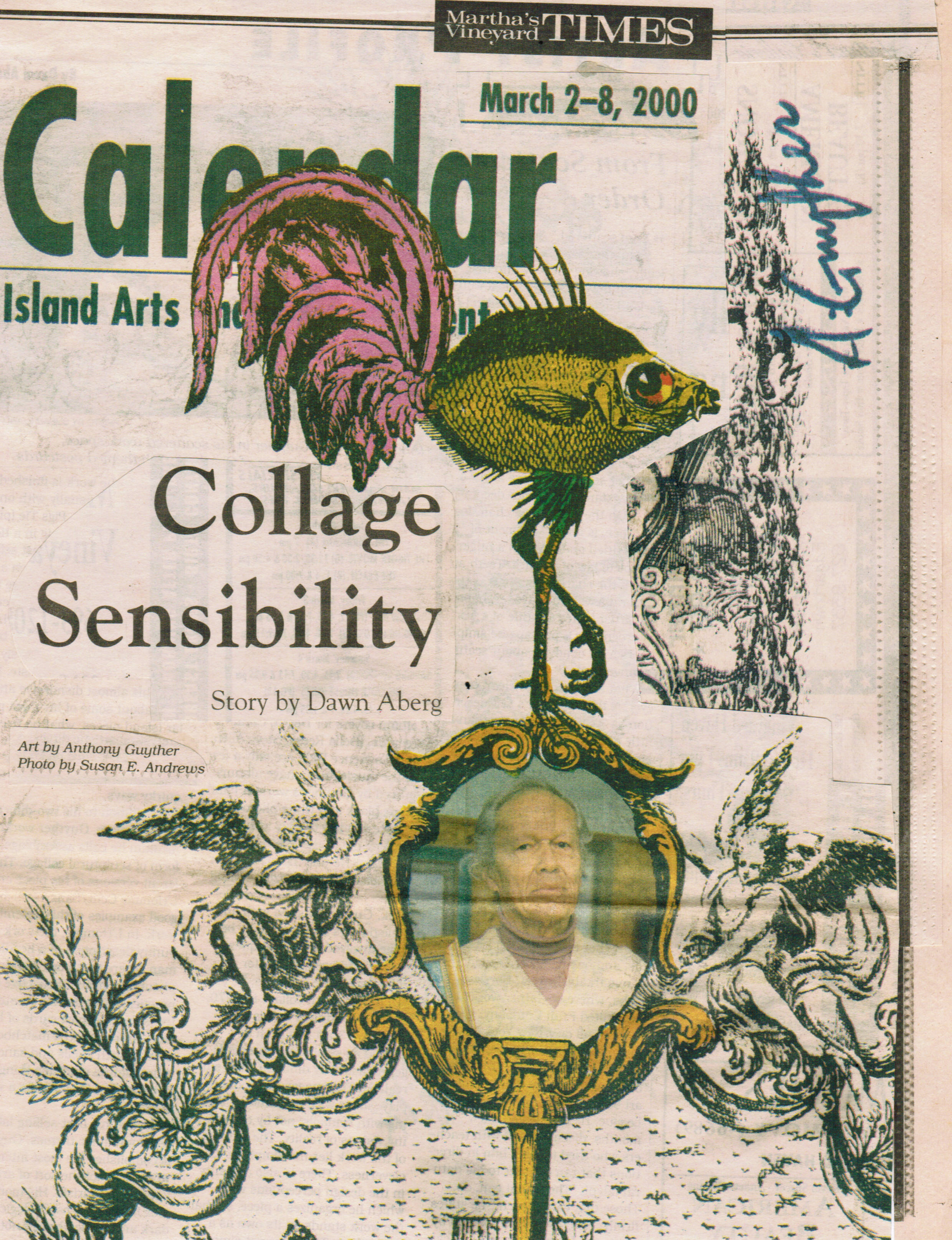
“Intricate Art From Scattered Order” by Dawn Aberg (Martha’s Vineyard Times: March 2-8, 2000)
“I am scattered,” Anthony Guyther says, a little apologetically, showing the way into his home and work space. It is a wonderland of quirky design and collage sensibility. The presentation is overwhelming. Framed pieces abound: on the walls, stacked neatly on the floors, covered in heaps in corners. Small antiques and collectibles grace every available surface, along with work Guyther sells to tourists in the summer. The viewer is not sure whether some pieces are art or a happenstance of interior decoration. On the seat of one chair, for instance, is an arrangement of small dried crabs within a huge complete jaw of a shark. Teeth and all. “If the shark doesn’t get you, the crabs will,” he says. Perhaps the artist states the title of a work in progress. Or perhaps he simply offers a bit of advice about seating arrangements.
What soon becomes clear, however, is that Guyther’s self-description as “scattered” is more than a little disingenuous. In fact, one begins to suspect a clever ruse put forth to test the visitor’s powers of observation and understanding. There is order here, a wild, baroque order, but order nonetheless. Guyther is clearly an artist who knows very well what he is about, an artist with a strong sense of design and compositition, and more than a few direct links to the collective unconscious.
Guyther has led a remarkable life, and has had a correspondingly remarkable career. Born in Cuba, where his father worked for the United Fruit Company, he grew up all over New York City — the Village, the Upper East Side. He attended public school in Brooklyn before going on for a brief time to art school at the Art Students League. He only lasted a few months, disenchanted with teachers who tried to force him in directions that ran counter to his natural talent. “Those that can, do. Those that can’t, teach,” he states firmly. “Picasso was not an art teacher.”
To support himself in New York, Guyther did magazine layouts and worked in advertising. Eventually he moved into photography, doing album covers for Decca/Coral records. (Della Reese, Steve Allen, and Lawrence Welk are only a few of the musicians to have albums graced by Guyther’s work.) A handsome black and white photo in his studio shows a store window display at night of work he did in the 1950’s for Bonwit Teller. He was the art director for Theater Arts Magazine during its run in the ’60’s. On a parallel track, Guyther worked with antique dealers and eventually became involved in the antiques business himself. Lucky for us, amidst all these activities, he began to work with collage in 1970, work he continues to this day.
Guyther’s art has been described as symbolist, an artistic genre distinctly different from surrealism. The images he produces play games with the mind by toying with symbols, not by contorting visions of reality. The interest of the work lies not simply in its cleverness. There is also a beauty in the design perceptions with which he organizes a piece, so that the work stands on its own as a work of art. These are not merely amusing decorative arrangments.
In composing one of his pieces, Guyther starts with a copy of a black and white engraving, usually of a human figure, which he has gleaned from his collection of old books. He keeps these engravings, along with images of birds, hands, mollusks, flowers, insects, and anything else you can imagine, in alphabetized files that he raids as the insipration comes to him.
Once he has chosen the human figure he wants to work with, he adds things that seem right, that seem to fit: different shapes and sizes of things. “Different things go together,” he says off-handedly, although in his work and mind they go together in some amazing ways. Over the finished composite image, Guyther adds a watercolor wash to excellent effect. He then mounts the image, using old frames (“they are better and cheaper,” he says) and mattes he has made himself using sponge painting techniques.
In most instances, Guyther says he has no preconceived notion of directions the work might take. Only when the work is finished does he title it, usually with one of the puns he favors. Pigs Tie (pig sty) is a picture of a pig in a tie. Fish Scales, one of his best sellers, is a person playing music on a keyboard imbedded in a large fish belly. There is also Bass Player in which a fish (a bass… get it?) is played like an upright string bass. The word games roll out endlessly out: Key of Sea, Tuba Toothpaste. Despite his almost dismissive attitude about some of his most popular Island pieces — what he refers to as the beach, shells, and fish stuff — the work is clever, combining words and images in wonderfully quirky ways.
In addition to his two-dimensional images, Guyther works in a medium he calls assemblage, a form of sculptural collage. The different versions of his piece entitled L’Homme Cent/Sans Tetes are good examples of this assemblage work. In L’Homme, the work is a punny description of a headless man covered with one hundred pictures of heads. Reflective of his practical bent, he also creates little trucs for sale: post cards of his work, intricate little matchboxes covered with shells and sand and other minute maritime things. As noted earlier, he inhabits a wonderland.
Beyond his best-selling Island, sea, and music themes, Guyther accomplishes his most interesting work. It is not the sort of art that appeals to tourists. His more complex images are psychologically dark and erotic (though not graphic) in nature. Here, a more sophisticated viewer can see Guyther’s rare talent come to the fore. In these pieces, with his idiosyncratic techniques of assembly and combination, he is able to create startlingly effective allusions to deeply textured human themes.
Guyther’s presentation of these themes, worked into the oddly formal and skewed juxtapositions of antique illustration, delicately and subtly colored in pale greens and reds, moves deep into the viewer’s imagination.
His most recent work is particularly striking. Two pieces completed since the beginning of the year stand out as exceptional. In Poseidon Bound, it’s the pale green ocean god confined in the grip of conflict instead of the mythically standard Prometheus. In Night Owls, a bird-headed female figure commands the center of the midnight image, surrounded by nocturnal consorts. As evidenced by these pieces, Guyther moves his technique in insistently interesting artistic directions. There is a depth to this work byond the obvious rational references.
Guyther’s work is shown summers at the Chicamoo Gallery and the Shaw Cramer Gallery, and year-round at the Marth’sVineyard Women’s Coop. You might catch the artist himself some days at the Tisbury Council on Aging, where he is a member of the executive board), or on beach walks in Vineyard Haven. But however you accomplish it, take some time to explore the “scattered” world of Anthony Guyther. You will be astounded by the discoveries you make.
Bloomsday Revisited
“Bloomsday Revisited” by Dawn Aberg (Martha’s Vineyard Times, June 21, 2001)
The literati so rarely give themselves something to celebrate, beyond the birthdays of dead authors. Maybe that’s why June 16 is such a beloved date for fans of words. Bloomsday. The date on which the events of James Joyce’s Ulysses unfold.
According to Joyce’s biographer Richard Ellman, the author seized on June 16 as a tribute to his wife Nora. It was, after all, on just such a Dublin Thursday in 1904 that he fell in love with her.
Perhaps because of the paucity of literary feast days, a rich tradition of Bloomsday celebrations has grown up in the last century. Year after year, with varying degrees of polish and sobriety, Joyce’s dense, punny word games and searing social insights have been shared among his admirers. By 1982, the tradition was formalized with public readings in Dublin and at Symphony Spacein New York City.
As is our Island wont, local observances of the holiday have taken on a special character. Over the last 23 years, Vineyarder John Crelan has produced and directed an eclectic, shifting mix of Joyceana, for a Bloomsday that changes on an annual basis. He avoids academic traditions of staid public readings, and veers instead in the direction of small performance bits, poetry and prose laced with music, songs which Joyce himself sand and admired.
No two Crelan Bloomsdays are alike. Last summer, 20 performers combined to present a complex, vaudevillian show. This past Sunday night’s performance at the Katharine Cornell Theatre was a simpler evening, not exactly a quiet one (there is a boisterous quality to these performances), but certainly more relaxed than last one. This year’s performance unfolded under a heavy summer rain.
And yes, last Sunday was June 17, not therefore Bloomsday proper. However as all good Joyce fans know, Bloomsday runs into the wee hours of the morning of the 17th, with Molly Bloom musing on life, love, and adulterous marriage well past the midnight of the 16th, in one of the most famous soliloquies in English literature.
So. Last Sunday seven players spun their tributes to Joyce one by one, with selections that revealed lesser known aspects of the author’s work (his radical political vision, for instance) as well as monologues based on its prototype: Homer’s Odysseus, proper.
Dublin born David O’Docherty opened the evening with a prologue of old, modal Irish tunes played on the tin whistle and a low pitched reed flute. In good Irish tradition, he mixed his music with storytelling and humor. “If you listen carefully,” he suggested, “you will hear fairy wings among the raindrops.”
Some tunes had names that were stories in their own right, as in “We Only Drink to Forget We’re Alcoholics.” But whatever its title, each air was granted its own remarkable introduction. “If you have tears, prepare to shed them now,” was one such launch into a tin whistle ditty.
Cahal Stephens, who has participated in every Crelan Bloomsday since 1989, performed a little known Joyce piece, a newspaper article written in Trieste in 190. “The Last Fenian” not only gives a history of the radical tradition of Irish politics. It conveys a sense of the fierceness of Joyce’s political critique, his gleeful reflections on the haplessness of the Irish political spirit. “In Ireland, at just the right moment,” Joyce wryly noted through Mr. Stephens’ voice, “an informer always appears.”
Music in the program underscored the close connection between music and words in Joyce’s work.
Singer Michael Calmes, accompanied ably by John Whiteside, performed classic 19th century Irish songs, songs Joyce himself was known to sing. With a clear sweet arc into his higher range, Mr. Calmes hung notes in the air in a classic Irish tenor style. But it was with a Benjamin Britten arrangement of “The Last Rose of Summer,” based on the traditional Irish air “Groves of Blarney,” that Mr. Calmes stole the audience’s heart.
Then it was on to Ulysses itself.
Boston actress Pam Rogers gave us this year’s Molly Bloom, the randy wife of Leopold. Ms. Rogers exuberantly pressed through the last pages of her famous soliloquy right up to the novel’s ineffable last line: “yes I said yes I will Yes.”
And Donal O’Sullivan handsomely portrayed her tormented alienated husband. As Bloom, he presented the flirtation with Gertie MacDowell, a pretty girl he comes to discover is lame. “Jilted beauty,” Mr. O’Sullivan mused in character. “A defect is ten times worse in a woman.” His mental peregrinations bring him back to the point where Molly leaves us: the moment in which the two not so much fell in love, as realized they could not escape each other.
By far the biggest treat of the evening was a last minute addition to the program, a wildly dramatic performance of Joyce’s poem “Gas from a Burner” by Gerry Yukevich. Dr. Yukevich stormed into the theater precisely as the feisty and scatology-prone Joyce would have done, slicing through lines the author had scratched out in a train station, an angry response to yet another publisher’s rejection. A scathingly ambivalent diatribe on Irish character, the poem is a good example of why James Joyce does not endear himself to the Celtic sentimentalist crowd, either in this country or in Ireland.
But for those folks who love a heretical romp through the darker side of Celtic tradition as their brand of Irish, stay tuned, Martha’s Vineyard. Same time, next year, but with no “same” about the ever-changing show. Be there for yet another Bloomsday. “Glory-O, Glory-O to the bold Joycean men,” to paraphrase a lyric. Don’t miss it.
*******
Vineyard Weddings: What Can Go Wrong – And How To Make It Right
 Dawn Aberg